
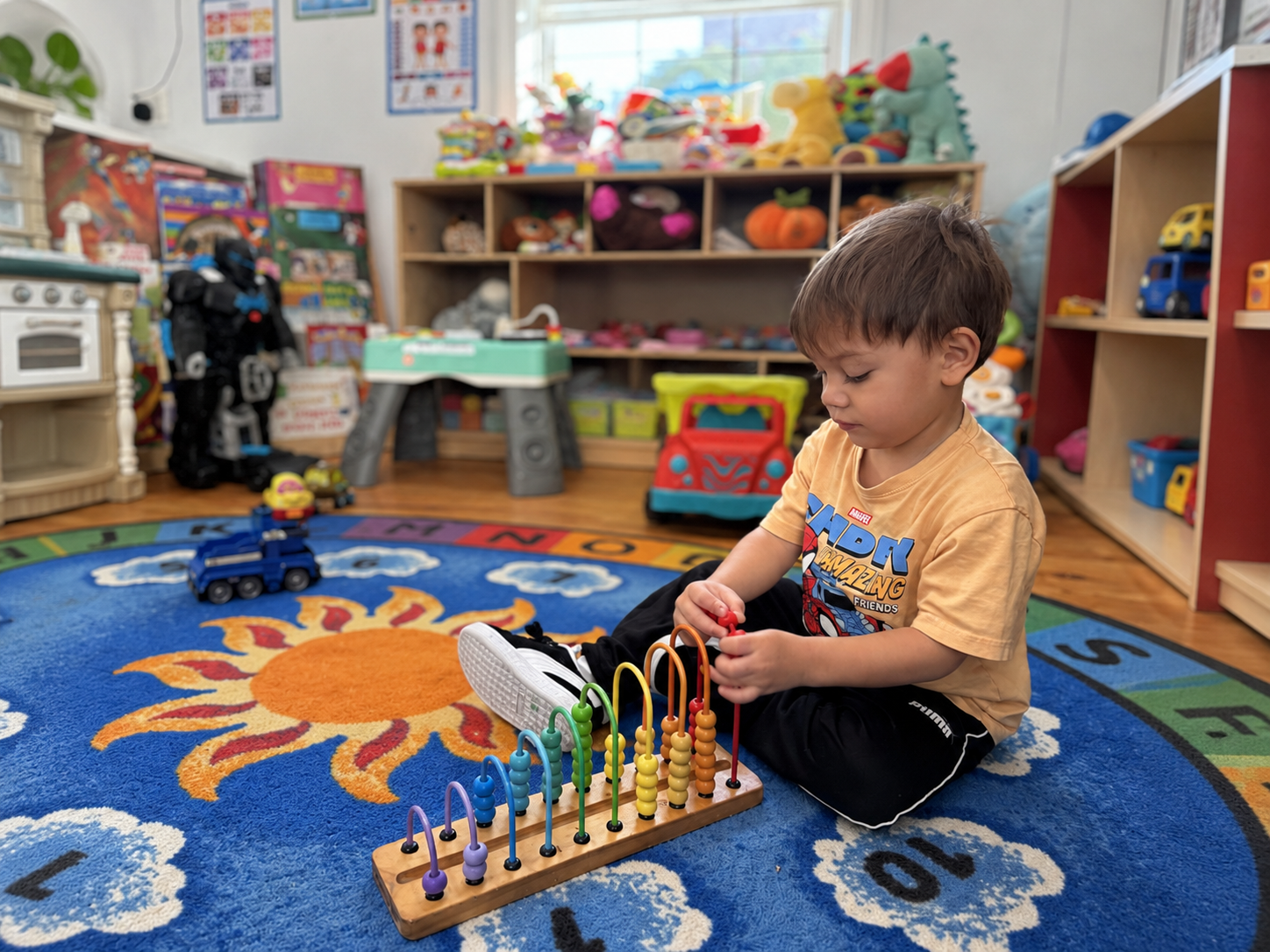
Walk into any quality early childhood classroom and you’ll likely spot one sitting quietly on a shelf or a colorful rug — the abacus. No batteries. No screen. No app required. Just rows of smooth beads on a frame, waiting for small hands to discover them.
In a world where children’s toys are increasingly digital, the abacus stands out not because it’s old-fashioned, but because it works. And it’s not alone. A whole category of classic, hands-on toys has quietly been doing some of the most important developmental work in early childhood for generations — and the research consistently backs them up.
What the Abacus Actually Teaches
Most parents see an abacus and think math. And yes — counting, number recognition, and basic addition and subtraction are all built into the tool. But the learning runs deeper than arithmetic.
When a young child slides beads across an abacus, they are:
Developing fine motor skills through the precise pinching and sliding motion Building one-to-one correspondence — the foundational understanding that one bead equals one number Practicing left-to-right tracking, which directly supports early reading readiness Strengthening hand-eye coordination through repetitive, focused movement Experiencing cause and effect in a concrete, satisfying way
That last point matters more than it sounds. Young children learn best when they can see and feel the direct result of their actions. The abacus delivers that feedback instantly and tangibly — something no digital counting app can fully replicate.
Why Hands-On Toys Outperform Screens in Early Childhood
The research on screen time and early childhood development is clear: passive screen exposure, even educational content, does not produce the same cognitive benefits as active, hands-on play. The reason comes down to how young brains are wired to learn.
Children under five are sensory learners. They build understanding through touch, movement, sound, and social interaction — not through observation alone. A toy they can hold, manipulate, stack, sort, or slide engages far more of the brain than one they simply watch.
Classic hands-on toys tap into this directly. They require the child to be the engine of the activity, not just the audience.
Other Classic Toys With Hidden Learning Power
The abacus is one of many traditional toys that punch well above their weight in the classroom and at home. A few worth knowing:
Wooden blocks — spatial reasoning, early geometry, cause and effect, and collaborative play all develop through block building. When a tower falls, a child is experiencing physics. When they plan before they build, they are problem-solving. Shape sorters — introduce classification, visual discrimination, and persistence. The frustration of getting the shape wrong and trying again is itself a developmental exercise in emotional regulation. Pegboards and lacing toys — target fine motor precision and concentration, two skills that directly predict kindergarten readiness Play dough and sensory bins — stimulate creativity, language development through descriptive play, and tactile processing Simple puzzles — build spatial awareness, problem-solving, and the deeply satisfying experience of completing something independently
None of these toys are flashy. That’s part of what makes them effective — they leave room for the child’s imagination and effort to fill the space.
The Role of the Adult in Hands-On Play
The toy itself is only half the equation. What makes classic toys especially powerful in a quality childcare environment is the presence of an engaged adult who guides, narrates, and extends the learning.
When a caregiver sits with a child at the abacus and asks “how many red beads did you move?” — that’s language development. When they count together out loud — that’s math. When they celebrate the child figuring something out — that’s social-emotional growth.
The toy opens the door. The relationship between the child and the caregiver is what makes the learning stick.
What to Look for in a Childcare Environment
If you’re evaluating daycare options for your child, pay attention to what’s on the shelves. A classroom stocked with open-ended, hands-on materials — blocks, puzzles, art supplies, sensory tools, and yes, an abacus or two — is a classroom built around how children actually learn.
At Tiny Hearts Childcare, our Bronx locations are designed with purposeful play at the center. The materials in our classrooms aren’t decoration. They’re tools — chosen intentionally to support the developmental stages of the children in our care.
If you’d like to see our environment in person and learn more about how we approach early childhood learning, we’d love to have you. Book a tour at Tiny Hearts Childcare or call us at (347) 297-3641. Come see where the learning happens — one bead at a time.